




As a supplier of metal dog feeders, I often encounter questions from pet owners regarding the impact of these feeders on the temperature of dog food. This topic is not only relevant to the well - being of our furry friends but also crucial for pet owners who want to provide the best for their dogs. In this blog, we'll explore the science behind how metal dog feeders interact with food temperature and discuss the implications for your dog's mealtime.
Understanding the Thermal Properties of Metal
Metals are known for their high thermal conductivity. This means that they can transfer heat very efficiently. When compared to other materials commonly used for dog feeders, such as plastic or ceramic, metal has a unique ability to quickly adapt to the surrounding temperature.
For instance, if you place a metal dog feeder outside on a hot summer day, the metal will absorb the heat from the environment rapidly. As a result, the food inside the feeder will also start to heat up. On the contrary, in a cold winter, the metal will lose heat quickly, causing the food to cool down faster than it would in a plastic or ceramic feeder.
Let's take a look at some scientific principles. The rate of heat transfer (Q) can be calculated using Fourier's Law of Heat Conduction, which is given by the formula (Q = - kA\frac{dT}{dx}), where (k) is the thermal conductivity of the material, (A) is the cross - sectional area through which heat is transferred, (\frac{dT}{dx}) is the temperature gradient. Metals generally have high values of (k). For example, aluminum has a thermal conductivity of about (205\space W/(m\cdot K)), while plastic has a much lower value, around (0.2\space W/(m\cdot K)). This significant difference in thermal conductivity explains why metal can have a more pronounced effect on food temperature.
Impact on Different Types of Dog Food
Dry Dog Food
Dry dog food is less affected by temperature changes compared to wet food. However, extreme temperatures can still have an impact. In a hot environment, a metal feeder can cause the dry food to become warmer. While this might not be harmful in itself, it could potentially change the texture of the kibble over time. The heat can cause the oils in the dry food to oxidize more quickly, leading to a shorter shelf - life and a less appealing taste for your dog.
On a cold day, the metal feeder will cool the dry food. Although dogs can still eat cold dry food, some dogs might be less enthusiastic about it. Pet owners may notice that their dogs take longer to finish their meals when the food is cold.

Wet Dog Food
Wet dog food is more sensitive to temperature changes. In a metal feeder, wet food can heat up rapidly in warm conditions. This can lead to the growth of bacteria, as the ideal temperature range for bacterial growth is between (40^{\circ}F(4.4^{\circ}C)) and (140^{\circ}F(60^{\circ}C)), known as the "danger zone." If the wet food in a metal feeder reaches this temperature range, it can spoil quickly, posing a health risk to your dog.
In cold weather, wet food in a metal feeder can freeze. Frozen wet food is not only unappetizing for dogs but can also be difficult for them to chew and digest. This can lead to a loss of appetite and potential digestive issues.
Our Metal Dog Feeder Products
We offer a variety of metal dog feeders to meet different needs. Our Portable Metal Dog Feeder is perfect for pet owners who are always on the go. It is made of high - quality metal that is durable and easy to clean. Despite its metal construction, we have designed it with some features to minimize the impact on food temperature. For example, it has a double - walled design in some models, which provides a layer of insulation between the food and the outer metal surface.
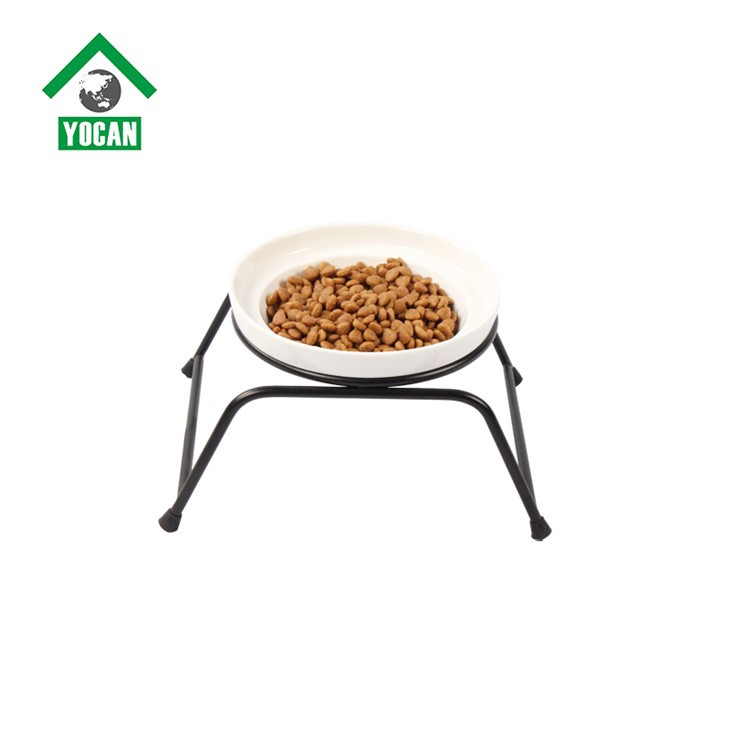
The Metal Dog Feeder Bowl Stand is another great product. It not only elevates the feeder to a more comfortable height for your dog but also helps in keeping the food at a more stable temperature. The stand is designed to reduce direct contact with the ground, which can be a source of heat or cold transfer.
Our Elevated Metal Dog Feeder is suitable for larger dogs. It offers the same benefits as the bowl stand, with the added advantage of being specifically designed for bigger pets. The elevated design helps in improving digestion and also reduces the rate of heat transfer from the floor.
Mitigating the Temperature Effect
If you are concerned about the temperature effect of metal dog feeders, there are several steps you can take.
- Use Insulating Mats: Place an insulating mat under the metal feeder. This can reduce the heat transfer between the feeder and the surface it is placed on, whether it's a hot patio or a cold floor.
- Limit Outdoor Use in Extreme Temperatures: Avoid leaving the metal feeder outside for long periods during very hot or very cold days. Bring it inside when not in use to maintain a more stable food temperature.
- Add a Lid: Some of our metal feeders come with lids. A lid can help in reducing the heat exchange between the food and the environment, keeping the food at a more consistent temperature.
Conclusion
In conclusion, metal dog feeders do affect the temperature of the food due to their high thermal conductivity. However, with proper understanding and the right products, you can minimize these effects. Our range of metal dog feeders, including the Portable Metal Dog Feeder, Metal Dog Feeder Bowl Stand, and Elevated Metal Dog Feeder, are designed to provide a balance between durability and temperature control.
If you are interested in our metal dog feeders and would like to discuss a purchase, please feel free to reach out to us. We are more than happy to answer any questions you may have and assist you in finding the perfect feeder for your furry friend.
References
- Incropera, F. P., & DeWitt, D. P. (2002). Fundamentals of Heat and Mass Transfer. John Wiley & Sons.
- National Sanitation Foundation. (2018). Food Temperature Danger Zone. Available from NSF official publications.