


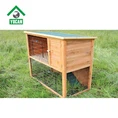


As a supplier of rabbit hutches, I understand the critical role that proper ventilation plays in maintaining the health and well - being of rabbits. A well - ventilated hutch ensures that fresh air circulates, removing harmful gases and odors while keeping the environment inside the hutch comfortable. In this blog, I'll share some practical ways to check if a rabbit hutch has proper ventilation.


1. Observe the Airflow
The first step in assessing ventilation is to feel the airflow around and inside the hutch. Stand near the hutch and use your hand to sense if there is a gentle movement of air. You can also hold a small piece of tissue paper near the openings of the hutch. If the paper flutters, it indicates that there is some airflow.
For our Wooden Triangle Shaped Rabbit Hutch, the unique triangular design allows for natural air movement. The slanted sides and strategically placed openings facilitate the flow of fresh air from the bottom and out through the top, creating a natural convection current. When you place your hand near the bottom vents of this hutch, you should feel a slight intake of fresh air, and near the upper openings, a gentle outflow.
2. Check for Odors
A poorly ventilated hutch will often have a strong, unpleasant odor. Rabbits produce urine and feces, which release ammonia and other noxious gases. If these gases are not properly ventilated, they can build up inside the hutch, creating an unhealthy environment for the rabbits.
When you approach a hutch, take a deep breath through your nose. If you detect a strong ammonia smell or a general musty odor, it's a sign that the ventilation is inadequate. In a well - ventilated 2 Stories Rabbit Hutch, the odor should be minimal. The multiple levels and ventilation channels in this hutch are designed to disperse the odors effectively, allowing fresh air to replace the stale air.
3. Look for Condensation
Condensation is another indicator of poor ventilation. When warm, moist air inside the hutch comes into contact with cold surfaces, it condenses into water droplets. Excessive condensation can lead to a damp environment, which is ideal for the growth of mold and bacteria.
Inspect the interior walls and ceiling of the hutch for signs of condensation. If you see water droplets or a damp, wet appearance, it means that the moisture is not being properly removed from the hutch. Our Triangle Shaped Rabbit Hutch is designed to prevent condensation. The well - planned ventilation system allows the moist air to escape, keeping the interior dry and free from excessive moisture.
4. Examine the Ventilation Openings
The size, number, and placement of ventilation openings are crucial for proper airflow. Check if the openings are large enough to allow sufficient air to enter and exit the hutch. They should not be blocked by debris, such as hay, fur, or dirt.
In our hutches, we carefully design the ventilation openings to ensure optimal airflow. For example, in the Wooden Triangle Shaped Rabbit Hutch, the bottom vents are wide enough to allow a large volume of fresh air to enter, while the upper openings are positioned to facilitate the expulsion of stale air. Make sure that these openings are clear and unobstructed at all times. You can use a small brush or a vacuum cleaner to remove any debris that may have accumulated around the openings.
5. Consider the Location of the Hutch
The location of the hutch also affects its ventilation. A hutch placed in a closed, confined space, such as a corner or a small shed, may not receive enough fresh air. It's important to place the hutch in an open area where there is good air circulation.
Avoid placing the hutch directly against a wall or in a spot where it is blocked by other objects. Instead, position it in an area where there is cross - ventilation, such as near an open window or in a well - ventilated room. If the hutch is placed outdoors, make sure it is not in a low - lying area where cold air can accumulate or in a spot that is constantly in the shade, as this can affect the airflow and temperature inside the hutch.
6. Evaluate the Temperature Inside the Hutch
Proper ventilation helps to regulate the temperature inside the hutch. In a well - ventilated hutch, the temperature should be relatively stable and comfortable for the rabbits. If the hutch is too hot or too cold, it can indicate a ventilation problem.
During the summer months, a well - ventilated hutch will stay cooler as the fresh air helps to dissipate the heat. In the winter, proper ventilation prevents the buildup of warm, moist air, which can lead to condensation and a damp environment. Use a thermometer to measure the temperature inside the hutch at different times of the day. If the temperature fluctuates significantly or is outside the optimal range for rabbits (around 10 - 20°C or 50 - 68°F), it may be necessary to improve the ventilation.
7. Assess the Health of the Rabbits
The health of the rabbits can also provide clues about the ventilation in the hutch. If the rabbits are constantly sneezing, have watery eyes, or show signs of respiratory problems, it could be due to poor ventilation. Ammonia and other pollutants in a poorly ventilated hutch can irritate the rabbits' respiratory systems, leading to health issues.
Regularly monitor the health of your rabbits. If you notice any changes in their behavior or health, such as a loss of appetite or lethargy, it's important to check the ventilation in the hutch. Ensuring proper ventilation is one of the key factors in keeping your rabbits healthy and happy.
In conclusion, proper ventilation is essential for the well - being of rabbits. By following these steps to check the ventilation in a rabbit hutch, you can ensure that your rabbits are living in a healthy and comfortable environment. At our company, we are committed to providing high - quality rabbit hutches with excellent ventilation. Our Wooden Triangle Shaped Rabbit Hutch, 2 Stories Rabbit Hutch, and Triangle Shaped Rabbit Hutch are all designed with ventilation in mind.
If you are interested in purchasing a rabbit hutch or have any questions about our products, please feel free to contact us for further details and to discuss your procurement needs. We are here to assist you in finding the perfect hutch for your rabbits.
References
- "The Welfare of Rabbits: Housing and Management" by The Rabbit Welfare Association and Fund.
- "Rabbit Husbandry: A Practical Guide" by various authors in the field of animal science.
- Research studies on small animal housing ventilation published in veterinary and animal welfare journals.