




Chicken Coop
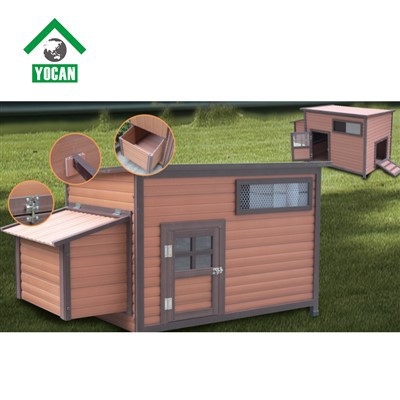
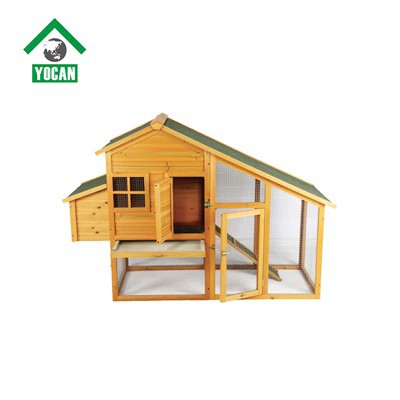
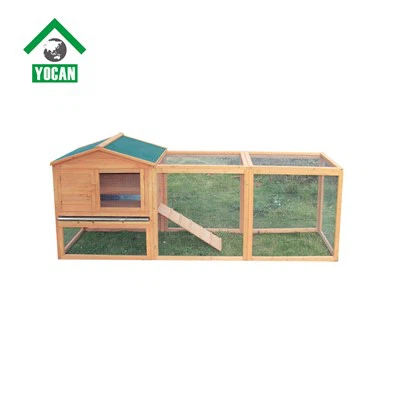
A chicken coop is a building where female chickens are kept. Inside hen houses are often nest boxes for egg-laying and perches on which the birds can sleep, although coops for meat birds seldom have either of these features. A coop may have an outdoor run. Both the inside and outdoor floors of a chicken coop are often strewn with a loose material such as straw or wood chips to deal with chicken droppings and to allow for easier cleanup. Most chicken coops have some means of ventilation to help air out any smells.
Advantages of Chicken Coop
Predator protection
An elevated coop will be less vulnerable to small predators, and all cracks, holes and crevices should be tightly sealed to keep out any predators looking to make a meal of your chickens. Windows should have sturdy mesh so no predators can enter.
Space
Your coop will need to be the right size to suit your flock and provide enough space for all your birds to be comfortable. The exact right size of your coop will depend on the number of chickens you keep, their mature size and whether you plan to expand your flock.
Ventilation
Fumes from chicken feces, decaying bedding and shed feathers can lead to respiratory problems in your flock, so good ventilation is essential for your coop. Windows are ideal, and you can also install vents or vent fans along the eaves or peak of the roof to ensure good air circulation.
Roosts
Your coop will need suitable roosting space for every chicken, and several levels of elevated roosts are best to meet the flock's hierarchy. An old wooden ladder or thick dowels can be great options for easy roosts in a homemade coop.
Why Choose Us
Our history
Zhejiang youqiang industrial co.,ltd was established in 2002 as a specialized manufacturer of pet products. Through years of efforts, our factory has 40,000 plus sq.M. Of standard factory buildings, new workshops for metal pet products and sales office in hangzhou.
Our product
Youqiang firmly believes that in order to gain a continuous development in the fierce competition of pet products, new products has to be developed. Until now we have developed a whole range of pet products, including over ten thousand item.
Our certificate
We have international certifications as iso9001 management system, fsc and bsci certication, passed the inspection by tuv, sgs, qcs, etc.
Production market
Main market in north america and europe, famous companies like petsmart,trixie, pets at home, fressnapf, costco etc.
Large coops
Larger coops are great for larger flocks—or, if you’re just starting, the potential for larger flocks. The pros and cons of this type of chicken coop depend on the amount of space in your yard.
Obviously, if you have a large yard and want a large number of chickens, this is the coop for you. However, larger coops can also be beneficial for smaller yards that don’t have the space for a free-roam area or an enclosed run.
When you’re thinking about the size of your coop, keep in mind how your flock will grow, how much space the chickens will need to move around, and how many nests your hens will need.
Small coops
For many backyard chicken keepers, their flocks are a side hobby, which means they don’t need or want more than a few birds. This is why a small chicken coop is a good idea—especially for first-timers.
One of the benefits of a small chicken house is that they’re easily assembled or even pre-built, and they’re usually easier to disassemble or move. Smaller coops are great when used alongside an enclosed run or when the chickens have the space to roam freely through the yard.
Even with a bigger flock, small coops make good isolation spots for sick or temperamental chickens.
Stationary coops
Stationary chicken coops are more permanent, as they aren’t made to be moved. They can be any size you need, and you can even build them from pre-existing structures such as a shed or part of a barn.
Generally speaking, stationary coops are sturdier, providing better protection from the weather and persistent predators. These types of coops are best for long-term chicken keepers who have yards or runs that are safe for their chickens all year round.
Mobile coops
Mobile, or portable, chicken coops also come in a wide variety of sizes to suit any flock. Some are small enough that you can move them on your own, while larger ones require a tractor or other vehicle to move.
The benefit of a mobile chicken coop is that you can easily move it from place to place, granting your feathered friends access to a broader range of environments. By moving them around, you give your chickens more space to roam freely and reduce the amount of damage they do to your yard.
These types of coops are also great for relocating your chickens to areas that offer better shelter from the weather or local predators. You can also consider a semi-mobile chicken coop, which gives you the best of both types of coops. These are designed so that you can move them, but you can also leave them in place for long periods of time.
Raised coops
Even with a small flock, chicken coops take up a significant amount of space, so it’s important to make the most of the room you have. Raised coops help you do this by granting extra run space beneath the coop for the chickens to wander and feed.
These offer an extra amount of shade and keep your chickens from having to deal with a wet or muddy floor. If you have a wooden chicken coop, the distance from the ground keeps it dryer and cleaner, making it less likely to rot. Raised coops are also easier to access than ones that rest on the ground, making your job much easier.
Wooden coops
A wooden chicken coop is a traditional favorite. It has served chicken farmers for hundreds of years. Wooden coops come in all shapes, sizes, and styles, and they give your yard a rustic look that perfectly matches your flock.
If you’re building your own coop—which can be an affordable and greatly rewarding process—wooden is the way to go. Just be sure to buy high-quality materials that will outlast exposure to the elements for years to come.
Plastic coops
One of the different coop types that are rising in popularity is the plastic coop. This can give your yard a more chic, modern look. As far as functionality goes, plastic chicken coops provide easy cleaning and are simple to take apart.
They won’t absorb moisture the way a wooden coop will, making them less likely to rot and degrade over time. Plastic coops are also more resistant to red mites and other parasite infestations since the material has fewer nooks and crannies for bugs to creep into.

Dimensions
Every chicken will need about two square feet of floor space, so plan your coop accordingly. Some larger breeds of chickens, like jersey giants, may even demand an extra foot or two of space per bird.
Nest boxes
Chicken coop nesting boxes should be about one square foot, and there should be a box for about every three chickens. When looking at nesting boxes for sale, it is always best to choose sturdy materials that suit your needs. You may want to look at plastic or metal boxes, which can easily be sanitized and cleaned. Roll away nest boxes can also make egg collection more efficient.
It is also important to provide at least two inches of clean nesting material for your nesting boxes, such as shavings or straw. Shredded newspaper, while convenient, is cautioned against because it retains excess moisture and could promote bacteria growth in your coop.
Coop ventilation
Ventilation is even more important than insulation. Make sure there are openings near the ceiling for air circulation. Chickens enjoy moderate temperatures but are perfectly capable of surviving the winter as well.
A door and a floor
A door can be as simple as a piece of plywood on a frame with a latch, but it should be designed to be big enough for you to enter and exit easily with your eggs or a chicken in your arms. And while a dirt floor is perfectly fine, if you do build a wooden floor, make sure that it is at least 6 inches off the ground.
Chicken breeds
The chicken breeds you choose to keep in your coop will affect the size you need because some breeds are smaller than others. Another consideration is mixing breeds. Certain chickens don’t like other breeds of hens and can be aggressive towards them if confined in close quarters.
Number of chickens
The more chickens you want to keep on your property, the greater the chicken coop size needs to be. The chicken coops we offer at pinnacle can comfortably house 3-4 chickens, maximum. When in doubt, start with fewer chickens and see how they react to their chicken coop size before adding more.
Weather
If your location experiences a lot of cold weather, including rain and snow, your chickens will spend longer in their coop. Chickens don’t like the cold, and if they are stuck in a small coop for too long, they can get frustrated and become aggressive toward other birds.
Free range
The approximation of space for chicken coop size assumes that your chickens will be roaming free during the day, with lots of room for stretching, flapping wings, and dust bathing.
Affection
When you’re raising chickens as pets, they need affection from their owners. Chickens that get pats are just happier birds, and when hens are happy, they are less likely to feel claustrophobic in their coop.
Rooster
If you have one or two roosters as part of your flock, you will need a bigger coop. Usually, one rooster is dominant, and the other rooster will need space to get away from him. Another alternative is to have separate coops for each rooster.
Cleaning
The smaller the coop you buy, the more frequent your coop cleaning will need to be. Chicken coop size affects cleaning because a bigger coop has more room for everything – including droppings. But faecal matter can quickly build up in a smaller coop, so keep this in mind.
How to Clean Chicken Coop
Take everything out…this includes your chickens!
On coop cleaning day, I make sure the weather will cooperate. We usually pick a nice day with a gentle breeze if possible. This allows for good ventilation and quicker drying time. Remove everything you can from the coop starting with your chickens. I set some of the girls’ favorite treats and water out in the run and blocked the coop door. This lets us get to work without tripping over chickens! Remove all feeders, waterers, nesting boxes, decorations, roosting bars (if possible), and anything else that’s collected chicken dust.
Scoop out dirty bedding
This is the icky part. I highly recommend wearing a mask for this part. Grab a shovel and a shop broom and get to work. When we had a smaller coop, we scooped the bedding into a wheelbarrow. Due to the larger size of our barn, we now use the tractor! Scoop and broom all the bedding out and bring it to your compost pile.
Spray out the coop with soap and water
We use warm, soapy water and wash down every area of the coop. My husband has a pressure washer that works great. If you don’t have a pressure washer, a garden hose and nozzle work just fine.
Dry the coop
This is the part where you get to utilize your patience. It’s very important for your coop to dry completely before you add new bedding! This will prevent mold and gross and unwanted bugs. When the coop is completely dry, I sprinkle coop recuperate on the floor and then add the new bedding. We use large flake pine shavings. After the bedding is down, I sprinkle another layer of coop recuperate on top.
Clean all feeders, waterers, roosting bars and nesting boxes
We scrub our waterers multiple times a year and our feeders get a good cleaning as well. Fresh food and water are vital to a healthy flock. I always add flock fixer into their water for a few days after coop cleaning. This helps the girls settle back into a routine with a clean coop stress free. We scrub the roosting bars and nesting boxes as well.
Put everything back in the coop
We bring everything back into the coop before we bring the flock in. That way, things are somewhat back to how they were when they reentered their home.
During the spring, summer, and fall, you’ll notice that your chickens love to scratch, peck, and forage outdoors. Chickens are usually happy in warmer weather because their ideal temperature is around 65 to 75 degrees fahrenheit, but they can be very tolerant of colder weather as well. Chickens have been domesticated for around 8000 years, so you can bet that they are good at surviving and acclimating. In the winter, you may notice that your chickens prefer to stay in the coop instead of foraging around outdoors. Chickens don’t really like to walk around in the snow, sleet, ice, or other wet, cold conditions because they lose a lot of their body heat through their feet. If there is straw or bedding laid out, your chickens may venture out in the cold weather for a while.
Although chickens prefer warmer environments, they are very tolerant of the cold. The first reason for this is that a chicken’s resting body temperature ranges from 104 to 110 degrees fahrenheit. They are hot-natured creatures and can keep themselves warm in colder weather. They also have uniquely layered feathers that they fluff up, trapping a layer of warm air between their feathers and skin. Their feathers act like a coat, keeping them warm and dry during the winter. Chickens have a high metabolism, and their hearts also beat up to 400 times per minute, which also helps to keep them warm.
Since chickens’ body temperatures are so high, they stay warm on their own when perched on their roosts at night. They also offer heat to their neighbors as they sit next to each other on their roost. As a group, the flock will keep itself nice and warm. You can think of each bird as a little heater, each one giving off the same amount of heat as a 10-watt lightbulb. If your coop is properly insulated and weatherproof, your chickens can produce enough heat on their own to keep the coop at a comfortable 40 degrees, even on the coldest mornings.

Our Factory
Zhejiang Youqiang Industrial Co.,Ltd was established in 2002 as a specialized manufacturer of pet Products. Through years of efforts, our factory has 40,000 plus sq.m. of standard factory buildings, new workshops for metal pet products and sales office in Hangzhou. Our factory is located in the maintain area of Pan'an County, Zhejiang Province, adjacent to Hangzhou City, close to Ningbo Port.


FAQ
We're well-known as one of the leading chicken coop manufacturers and suppliers in China. Our factory offers high quality chicken coop made in China with competitive price. Welcome to place an order.