

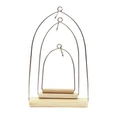
Butterfly Insect House
A butterfly insect house, conservatory, or lepidopterarium is a facility which is specifically intended for the breeding and display of butterflies with an emphasis on education. They may also be used to support local populations through butterfly release. Some butterfly houses also feature other insects and arthropods. Butterfly houses are owned and operated by zoos, museums, universities, non-profit corporations, and private individuals as part of their residence; as well as small businesses that are owner operated. They include compartments made from natural materials like bamboo tubes, pine cones and straw.
Advantages of Butterfly Insect House
Get closer to nature
While they’re beneficial for insects, they’re also good additions for people too. For little ones, they provide an opportunity to get closer to nature and learn about how balanced ecosystems and biodiversity work.It also teaches children not to be afraid of insects, giving them a better understanding of their role in our ecosystem and what they’re bringing to your garden.
Conservation
They can help to supplement the increase in loss of natural habitats, providing refuge to insects so that they can nest and hibernate without the risk of having their home destroyed.Giving a home to bugs that are losing their natural habitat helps to ensure that they can continue to survive and thrive.
Pest control
Many of the insects that your hotel can attract are beneficial, and one of these benefits is free natural pest control that saves the need for chemical solutions.Creatures such as ladybirds will help deal with any aphids in your garden so that your plant life stays strong and healthy.
Pollination
Other types of beneficial bugs are the pollinators. Solitary bees pollinate plants in your garden, including everything from ornamental flowers to food crops.It’s not just bees either – a variety of other insects also fill this role including beetles, butterflies and more.


Why Choose Us
Our history
Zhejiang youqiang industrial co.,ltd was established in 2002 as a specialized manufacturer of pet products. Through years of efforts, our factory has 40,000 plus sq.M. Of standard factory buildings, new workshops for metal pet products and sales office in hangzhou.
Our product
Youqiang firmly believes that in order to gain a continuous development in the fierce competition of pet products, new products has to be developed. Until now we have developed a whole range of pet products, including over ten thousand item.
Our certificate
We have international certifications as iso9001 management system, fsc and bsci certication, passed the inspection by tuv, sgs, qcs, etc.
Production market
Main market in north america and europe, famous companies like petsmart,trixie, pets at home, fressnapf, costco etc.
Protect it from birds
They will hang out waiting for a meal. Fasten wire mesh or netting to your nesting areas and overwintering shelters. Animals can easily recognize mesh or blue plastic netting and they pose no threats to birds.
Avoid hazards
Bee wings can be easily damaged. For this reason, you should make sure all pipes, stalks and boards are sanded smooth. Make sure to drill holes into the cut face of the log parallel to the bark.
Respect biorhythms
Don’t move your insect hotel from the original spot where you placed it – not even in winter. If you move it to a warm garage or basement, you risk waking the insects up from their hibernation. But they won’t be able to find any food in winter. You don’t need to do anything to prepare for the winter or provide a warm cover.
Keep these instructions on hand
It’s very important to choose the right materials. Before you start building, read the instructions on the proper materials to use and make note of the tips provided. This way your hotel will attract lots of guests.
Store-bought or diy
Nowadays you can find a large selection of insect hotels and kits that you can buy. If you decide to buy one, make sure that the materials are of very high quality. Straw, spruce cones, sawdust, wood chips and similar materials are indications of cheaply made versions. Building your own hotel will of course take some time. But if you use found and recycled materials, it will be a lot cheaper.

Much like birdhouses, butterfly houses come in many shapes and sizes, from a simple wooden box with a slanted roof to elaborate architectural miniatures of beach cottages, log cabins, churches, and garden sheds. Unlike a birdhouse, a butterfly house has long, narrow slots rather than a round hole. In theory, these slots allow access to butterflies but keep the birds out.
When shopping for a butterfly house, look for one that opens in the back for easy cleanout. You will also want to place a piece of bark or a small branch inside for butterflies to perch on if one should happen to be so inclined. If you are a do-it-yourself person, a variety of butterfly house plans can be found on the internet. Make sure you use untreated lumber; pine and cypress are preferred.
Tip: Butterflies are attracted to bright colors: Pink, purple, red, and yellow. Try painting your house in a caribbean color scheme, or cover it with big bright flowers. Seal your paint job with a clear coat to make it last longer.
Butterfly house residents
Charming in any setting, butterfly houses are often thought of only as garden ornaments. Unfortunately, in most cases this is true. Coaxing butterflies to actually use the house requires knowing which species of butterflies will use it and what habitat they require. Mourning cloaks, tortoiseshells, angel wings and red admirals are some of the butterflies that might take refuge in a butterfly house during the winter.
House placement and landscaping
Place your butterfly house approximately four feet high on a post, fence, or tree in an area sheltered from strong winds. Wind movement makes butterflies feel unsafe, so it is not a good idea to hang the house where it might sway. The edge of a wooded area is an ideal location; the trees provide a safety factor while the open area provides room for nectar plants.
Host plants should be planted nearby. Willow, elm, buckthorn, nettles and hops serve as host plants for the butterflies mentioned earlier. Plant a variety of nectar plants around the butterfly house such as asters, milkweed, phlox, purple coneflower, and wild bergamot.
A butterfly house is a beautiful addition to any garden. If you need more info on creating a butterfly garden, we have that too! Follow the steps and you might just be delighted when these amazing winged insects make your house their home.
Place the butterfly insect house as close as possible to the area that you want the insects’ help pollinating and protecting. You may also place the house where you have already noticed the desired insects’ activity. A flower bed, garden, blossoming trees, bushes or stumps are good locations.
The insects prefer a warm, dry place protected from the wind and rain with exposure to plenty of sunlight. Morning sun is important; it gets the insects warmed up and out earlier each day and helps with an earlier hatch for the bees in the spring. Be sure that the front of the house is facing away from the typical incoming rain patterns in your area.
The house should be mounted at about eye level on a secure fence or arbor post to keep it from moving around too much when windy. It’s important that it be placed in a location where it will not be bumped or disturbed, so it’s recommended to avoid high traffic areas in the yard or garden.
Insect houses do not require cleaning or replacement parts. Instead, it is recommended to replace the entire house after a few seasons of use as the materials become worn and more susceptible to bacteria and disease. You may encounter some sources that suggest using a pipe cleaner to remove remnants of pollinator activity, however these insects are capable of excavating mudded tubes and blocks and will reuse the house again next season.
It’s a good idea to monitor any shutter chambers for unwanted insect activity (for example, paper wasps building a nest). The shutter chambers on all beneficial insect houses can be opened for easy monitoring and early eradication of unwanted or aggressive insects.
The house can be left outside through the winter since this mimics the natural environment of these insects. If there is concern about exposure to extremely harsh elements or predation from birds, the entire house can be brought into an unheated garage. Be careful not to put the house in an environment that is too warm as this could cause an early or premature hatch.

Provide food
Making your garden an attractive space for an insect starts with food. Adult butterflies get their energy from nectar, and they visit gardens looking for flowers to feed on. Grow nectar-rich flowers in the spring and summer months to encourage them.
Adult butterflies enjoy bluebells, marigolds, buttercups, hyacinth, clover, garden mint, knapweed, thistles, blackberry bushes, heather, lavender, bowles' mauve wallflower, marjoram and willowherbs, among others.
Create warmth
Butterflies enjoy warmth. Try to pick out spots where the sun hits to cultivate your plants. Butterflies also need room to fly, so create a flowerbed full of nectar-rich plants alongside an open area of patio or lawn.
Think about your area
Do some research on butterflies native to where you live. Find out what they feed on and try to provide food for the caterpillar stage of the butterfly life cycle.
Species including the painted lady and the large white have a wide distribution across the uk, but the white admiral only thrives in warmer, southern climates.
Maximise window boxes
Even people without a large garden can encourage wildlife to thrive. Many plants are at home in a window box or on a patio, including marigolds, yarrow and lavender.
Leave fallen fruit on the ground
Butterflies need food to be available from the early spring through to late summer. In august, some species will feed on the sugar inside discarded fruit.
Rotting pears, apples and berries are popular. Butterflies struggle to consume anything too hard, so if you leave fruit out on the compost heap, the riper the better.
Cut down on weeding
You can’t have butterflies and moths without caterpillars. Support their growth by allowing your garden to be wild around the edges.
Larvae like to feed on nettles, thistles, ragwort, mixed grasses, holly and ivy, which means that gardeners should welcome some of the less popular wildflowers.
Avoid pesticides
Pesticides are harmful to butterflies and other pollinating insects. Avoid using them near your flowering plants, and be aware of plants bought from the garden centre that may have previously been treated.
Create shelter
Butterflies are cold-blooded creatures and get their warmth from the sun. Summer doesn’t always bring sunny days, and when it rains, butterflies shelter under large leaves or in sheltered spots.
'Most species wait out the winter as eggs, larvae, or chrysalises and they’ll be hidden in gardens and parks. Try not to tidy up too much over winter. Let leaves gather and keep pruning to a minimum. That way your garden will be full of butterfly colour next spring.'
How Do Butterfly Insect House Work
An insect, bug or bee hotel is something most gardeners have seen before. But many ask themselves the question: How does an insect hotel actually work? In fact, the insect house has several uses. On the one hand, it serves as a shelter for various species of insects. However, reproduction is one of the main tasks of the bug hotel. The various materials of the insect nesting aid replicate natural shelters, which are normally used by insects as breeding burrows. Thus, the beneficial bug hotel is primarily a nesting aid for insects, as known, for example, from nesting boxes for birds. However, some bug hotel inhabitants also use them as hibernation aids.
But where is the best place to put an butterfly insect house? There is no general answer here: If you pay attention to a sunny, protected location, you can place the bug hotel both on a house wall, and free-standing in the garden or on the balcony. Proximity to humans is not a problem for most insects. However, when locating the bug hotel, it is important to ensure that there is an adequate supply of food nearby: Insect-friendly perennials and shrubs and insect-friendly flowers should be no more than 300 metres from the nesting aid to ensure that the animals feel comfortable. The more different insect-friendly plants are offered, the better. Diverse seed mixes are suitable here. Due to their diversity, they serve as a food source for various insects. In addition, wild bees in particular need sufficient raw materials such as water, sand and clay in the immediate vicinity to expand their nesting cavities. If you do not have these raw materials in your garden yourself or would like to set up the bug hotel on your balcony, you can also provide the natural materials you need on shallow bowls nearby.
Our Factory
Zhejiang Youqiang Industrial Co.,Ltd was established in 2002 as a specialized manufacturer of pet Products. Through years of efforts, our factory has 40,000 plus sq.m. of standard factory buildings, new workshops for metal pet products and sales office in Hangzhou. Our factory is located in the maintain area of Pan'an County, Zhejiang Province, adjacent to Hangzhou City, close to Ningbo Port.


FAQ
We're well-known as one of the leading butterfly insect house manufacturers and suppliers in China. Our factory offers high quality butterfly insect house made in China with competitive price. Welcome to place an order.
wall-mounted insect house, cute insect house, sustainable insect house