

Squirrel House
Squirrel houses offer a cosy and protected place for the squirrels in your garden to hide and nest. You can support these charming, sometimes troublesome garden inhabitants by giving them a dedicated space to shelter and raise their young.Providing specially curated nesting spaces for endangered red squirrels can help their numbers to increase in the wild. If you’re lucky enough to live in an area where red squirrels are still present, these squirrel houses are specifically developed for use by red squirrels, but are also suitable for grey squirrels and hole dwelling birds.
Advantages of Squirrel House
Pest control
Many people think of squirrels as a pest, and seek squirrel removal services to rid their property of these animals. However, completely removing squirrels from an area would do a disservice to the ecosystem since squirrels help to eliminate other pests that people find bothersome.
Entertainment
Squirrels can act pretty silly, with the way they dash around and forage for food. They are a good source of entertainment for humans and pets alike and can make for a fun time when sitting in your backyard. But keep in mind that while squirrels are having their own fun, they are likely leaving behind urine and fecal droppings in your yard and on your porch. This waste is especially damaging to wooden structures, as the liquid can, over time, ruin the integrity of the structure.
Assistance in spreading seeds
Squirrels eat seeds, and in the process, they can spread those seeds around your property and increase the biodiversity of your land. But there is just as great of a chance that some seeds they plant will grow into a weed or some other unwanted plant.


Why Choose Us
Our history
Zhejiang youqiang industrial co.,ltd was established in 2002 as a specialized manufacturer of pet products. Through years of efforts, our factory has 40,000 plus sq.M. Of standard factory buildings, new workshops for metal pet products and sales office in hangzhou.
Our product
Youqiang firmly believes that in order to gain a continuous development in the fierce competition of pet products, new products has to be developed. Until now we have developed a whole range of pet products, including over ten thousand item.
Our certificate
We have international certifications as iso9001 management system, fsc and bsci certication, passed the inspection by tuv, sgs, qcs, etc.
Production market
Main market in north america and europe, famous companies like petsmart,trixie, pets at home, fressnapf, costco etc.
Design with squirrel’s needs in mind: Keep any structures you build as open-concept as possible. Fewer walls help prevent squirrels from being cornered by potential predators, like neighborhood pets or large birds. It also helps them poop off the side of the structure, not in it. That’s critical, because if you encourage squirrels to congregate, the risk of disease transmission increases. (plus, scrubbing squirrel poop from inside a structure the size of a doll house is more difficult than hosing off splotches from your lawn.)
Never use treated wood or plastic products: Treated woods and plastics contain chemicals that could pose a health risk to your squirrels, whether through consistent exposure or consumption. Instead, “find untreated wood and cut shapes” to creatively decorate any structures, says elizabeth carlen, an urban evolutionary ecologist whose postdoctoral research at washington university in st. Louis involves squirrels. Whimsical arches, inclines, geometric objects, and climbable towers can all be carved using untreated wood for a very “hygge playroom” vibe.
Go natural with colors: Since squirrels may unintentionally digest any flakes if they claw or gnaw on the structure, best to skip the paint and varnishes. Squirrels chew everything they can get their hands on, dantzer warns, a destructive tendency that means you must take care not to incorporate any materials that could hurt them. Instead, use natural dyes on wood, or employ natural fabrics for the structure. Coffee beans, herbs, nut husks, tobacco, and even iced tea can be used to dye wood, whereas an array of flowers, berries, and other produce can be used to change the color of fabrics.
Be cautious with wiring or light placements: Squirrels and electricity don’t mix, even though squirrels remain oblivious to this fact, continuing to cause power outages every year. If you want to illuminate the structure, think of indirect ways to do so that aren’t near anything the squirrels may want to eat.
Dispose of any damaged products: Whether it’s because of bad weather, long-term exposure to the elements, or gnawing, a squirrel house structure won’t last forever. Replace any sections that seem to be falling apart, decomposing or otherwise look like they’ve seen better days.
Know what to serve at mealtime: While a milkshake will probably bring all the squirrels to your yard, any food you leave out for them should reflect their typical diet. That means nothing with salts or sugars. Plain nuts and seeds—anything that would come in a bird feeder bag—should be the go-to. Consult a local wildlife agency about the types of squirrels in your area to make sure you’re providing what makes sense for their diets.
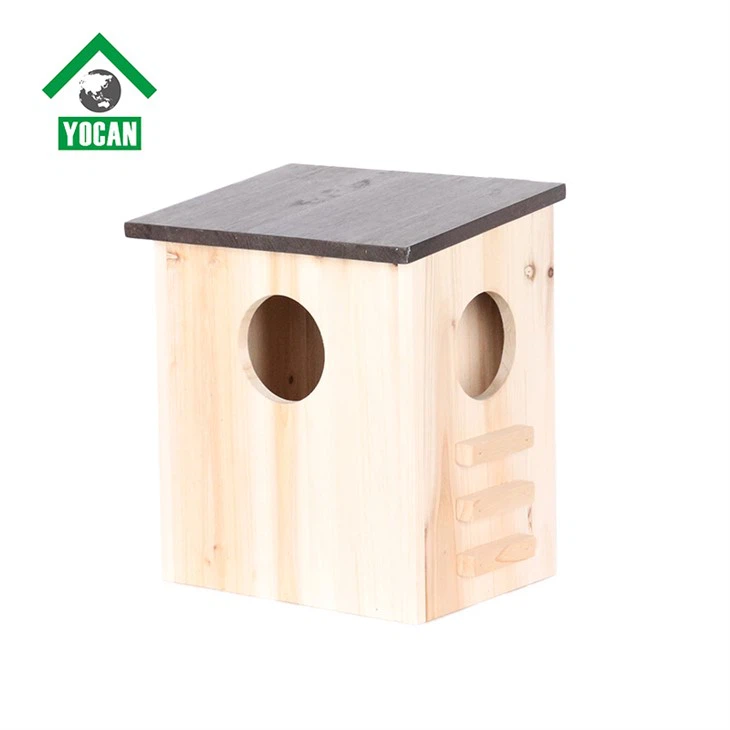
The squirrel condo
This could be a great home for a squirrel in hot regions, but here in the pacific northwest, we call this a box of water hanging on a tree.The back board makes this house easy to install. Roof slope is angled to allow rain to run off but gentle enough for comfortable perching on roof. Squirrels will enjoy sitting on the bottom ledge as well. Cedar discourages ectoparasites like fleas.
The ejector box
Multiple entry and exit points make it easy for a squirrel to make a quick escape. This box is really only appropriate for indoor use or in a protected area, like a pre-release enclosure .
The risky box
Drainage on the bottom is important as many boxes fill with water during heavy rains, and you want to ensure that the bedding can dry. The back opening facilitates cleaning the box periodically. The back board permits the box to be nailed to the tree. You would need additional hardware to attach the box at the top. The ventilation slot at the top makes this box a good choice for hotter climates where the box must be designed to allow heat to dissipate quickly. Squirrels will chew on the box, so select boxes with untreated wood to prevent ingestion of toxins. If you must paint, select a non-toxic finish.
As squirrels spend their days running up and down trees and jumping from branch to branch, they have a bird’s-eye view of home roofs and their weaknesses. Squirrels can jump four feet vertically and jump six to eight feet horizontally.
Because squirrels do not hibernate in winter, the warmth they feel coming from gaps makes an ideal winter den. Squirrels will use their teeth to gnaw through damaged or unscreened vents or tiny gaps to enter the attic. And they most often use the branches of trees near the home or wires to get to the roof. While ideal for squirrels, their presence damages homes and poses health risks for the families within.
Squirrels only need a gap of 1.5 inches to gain entry. The most common places where squirrels find entry into your attic include:
Soffits – These are the finishing material, mostly made of wood or fiber cement, that covers the underside of a roof overhang. In addition to helping to make the roofline look aesthetically nice, soffits help keep moisture away from the rafters, reducing the chance of mold. Soffits that are not flush with the siding create a gap for squirrels to enter.
Fascia boards – These are thin longboards that run along the lower outer edge of a roof, covering the entire roofline. They help keep water out.
Ridge vents – Ridge vents are air exhaust vents installed on the peak of a roof that provides continuous exhaust ventilation at the highest part of the attic. Squirrels are attracted to the warm air that comes out of these vents.
Gable vents – On a gabled roof, these vents are located at the peak where the two sides meet. They usually have louvers, allowing air to flow into the attic, which works to cool it down in warm weather.
Roof returns – This is the part of the roof that doubles back to the wall of the house. It is between the end of the roof and a home’s walls.
Chimneys – Chimneys conduct smoke and combustion gasses up from a fireplace, stove, or furnace and can run through the attic of a house.
Siding corners – This is the trim used to keep your siding in place where the corners meet.
Gutters – Gutters capture rainwater and melting snow and channel it away from the house. Clogged gutters that prevent precipitation from running will cause deterioration along the roof edge through which a squirrel can enter.
Plumbing mats – This is rubber matting covering cylindrical vents on the roof that connect the plumbing system used to exhaust gasses.
How To Attach A Squirrel House To A Tree
The first step in installing a squirrel house is to get two large nails and a ladder. A long ladder is recommended so that you can work safely without the risk of falling. Make sure you have a partner to help you. Once you have the ladder and the nails, start driving the first nail into the tree. Drive the second nail eight inches later parallel to the first one. The squirrel house should fit between the two nails.
Putting up a nesting box
If you have a tree in your yard, consider putting up a squirrel nesting box. Squirrels do not need human help to build their nests, but they do need a tree that is mature enough to support their family. Mounting nesting boxes to young trees or to other structures will increase their habitat. You don’t have to use fancy boxes to attract squirrels; plain wooden boxes are more attractive to them.
To attract squirrels, make sure to place the nesting box at least 10 feet up in a tree that is in woodland. Squirrels normally build nests higher than this, and it is best to place the nesting box at an appropriate height. You can fill the box half way with bedding matter. The boxes are made from cedar and are a great option for the budget-conscious homeowner.
Positioning it so that winter wind won’t whip into it
If you’re building a squirrel house, you should remember that the measurements don’t have to be exact; you just want it to be large enough to hold the required number of squirrels. Measure 18 inches from one end of the sideboard and 17″ from the other edge. Using a ruler, mark the lines and cut along them. Cut as squarely as possible, but take care to make a clean cut, not a lopsided one.
A squirrel house should face south and be firmly attached to a tree branch. Place the house so that the entrance is high enough that predators cannot reach it. Once attached, you can place it on a wooden post. A squirrel house should be high enough off the ground to keep predators away, but low enough so that it’s not in a tree’s way.
Design of a squirrel house
The perfect squirrel house must have two round holes and an outlet close to the tree trunk. The entrance should be at a height where the squirrel can reach it from all sides. A platform should be placed in front of the entrance, but it is not necessary. A steep roof will provide the squirrels with more support than a flat roof. For aesthetic purposes, a steep roof is better, but the squirrels will enjoy the look of a flat roof as well.
The front panel of the squirrel house must be at least three inches shorter than the back panel. To do this, you must measure the 18″ side board at three inches from the edge. You can use a measuring tape to measure three inches from one edge, then mark the 17″ sideboard at 18″. After marking the sides, cut the planks along the lines. Make sure that the cut is clean, since the house is not finished yet.
Building a nesting box for squirrels
Squirrels have a need for a secure and convenient place to make their home. They need a tree that is about 10 feet or higher, out of the way of prevailing winds. Mounting a nesting box on a tree is a great way to provide this habitat. You do not need to purchase fancy nesting boxes for squirrels. A simple, wooden box will do just as well.
Our Factory
Zhejiang Youqiang Industrial Co.,Ltd was established in 2002 as a specialized manufacturer of pet Products. Through years of efforts, our factory has 40,000 plus sq.m. of standard factory buildings, new workshops for metal pet products and sales office in Hangzhou. Our factory is located in the maintain area of Pan'an County, Zhejiang Province, adjacent to Hangzhou City, close to Ningbo Port.


FAQ
We're well-known as one of the leading squirrel house manufacturers and suppliers in China. Our factory offers high quality squirrel house made in China with competitive price. Welcome to place an order.