

Hamsters are cute and adorable. Many people choose hamsters as their pets. However, hamsters are small and have fragile vitality. You need to be extra careful when raising them. If you are not careful, it will affect their life and health!
Today, I have sorted out some precautions about hamster breeding, including the hamster breeding environment, basic consumables for hamster breeding, hamster diet, and things not to do when raising hamsters. I suggest you collect them first and keep them for later reading!
Hamster breeding environment
1. Hamsters will feel uneasy when they first arrive in a strange environment. Some hamsters will even have diarrhea symptoms due to fear. They should be placed in a relatively quiet place to let them adapt to the new environment. Don't rush to hug them.
2. The suitable living temperature for hamsters is 20-28°C, and the temperature difference does not exceed 10 degrees. When the temperature is too low, they will fall into pseudo-hibernation, so pay attention to keeping them warm in winter.
3. The cage should be placed in a place away from direct sunlight or direct wind, but pay attention to ventilation.
4. The cage should not be too close to the TV, stereo, or computer. Radiation and noise should be avoided.
5. Avoid direct sunlight on the hamster. In winter, you can place it in a room where you can feel the sunlight to increase the temperature. In summer, you need to cool down.
6. Do not turn on the air conditioner for hamsters in summer. The temperature difference caused by turning on and off the air conditioner may cause the hamster to catch a cold.
7. Do not put the hamster outdoors in winter. It will hibernate if it is too cold. You can put the entire cage in a cardboard box or a wooden box and pay attention to ventilation.
8. The activity of the hamster is large. Insufficient exercise can easily make the hamster unhappy. In severe cases, it will cause depression.
9. The living space of the hamster should not be too small. The space should at least have water bottles, food bowls, small nests, running wheels and other supplies.
Basic supplies for hamsters.
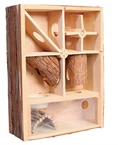
10. Hamster cage: The cage is a must-have for raising hamsters. The minimum standard for raising dwarf hamsters is 47 bases and that for chinchillas is 60 bases, but of course the bigger the cage, the better.
11. Bedding: In spring, autumn and winter, wood chips are mainly used, which can be matched with deodorizing paper pellets, flower and grass mats, etc. In summer, urine sand and paper cotton are mainly used. Generally, it is changed every 10 days or so, and it can be slightly more frequent in summer. When replacing new bedding, you can put a little bit of the previous bedding
12. Water bottle: The safest and most convenient way for hamsters to replenish water is to drink boiled water. You can choose a special water bottle suitable for the size of hamsters.
13. Food bowl: You can buy it or not. The mouse food can also be scattered in the cage and let the hamsters collect it by themselves.
14. Hiding house: Try to choose a larger hiding house
15. Running wheel: It is recommended to choose a running wheel with a diameter greater than 20cm for dwarf hamsters, and at least 26cm for bear hamsters. The specific diameter is selected according to the body size of the mouse. Make sure that the body is stretched on the running wheel. Too small will affect the growth of the hamster's spine.
16. Sand basin: It is used for hamsters to go to the toilet and take a bath. Specially designed litter boxes are generally more expensive, but there are many 0-cost alternatives: unused small plastic boxes, large bowls, small flower pots, etc.
17. Bath sand/urine sand: Although hamsters love cleanliness, most of them really can't tell the difference between bath sand and urine sand (it varies from hamster to hamster~). To them, they are the same. Many hamsters will use urine sand to bathe, and sand with their own smell makes them feel more at ease~ Many hamsters bathe and urinate in the same place, so just buy a high-quality urine sand, and pay special attention to the dust problem!
18. Hamsters drink 10-20ml of water every day, which changes with the weather and food. They drink more water in summer.
19. Hamsters like to hide food in their cheek pouches. At this time, we must pay attention to the time. If the time is too long (about 1 day), there are still a lot of things in their cheek pouches. At this time, we need to clean it out to avoid inflammation.
20. Hamsters need to be fed regularly in the evening or evening, and the amount is about 5-10% of their body weight. Hamsters' diet mainly comes from feed, and it is not suitable to be fed human food, such as snacks and milk.
21. Teeth grinding feed: Please do not use unidentified earthy yellow feed, which is cheap but the ingredients are unknown!
22. Drinking water: Please use boiled cold water, not tap water
23. Dry food: including nuts, seeds, cereals and hay. When choosing dry food, you should choose high-quality, natural and low-sugar foods, and avoid adding chemicals, preservatives and flavors.
24. Fresh fruits and vegetables: Fresh fruits and vegetables are an indispensable part of hamsters' daily diet. A variety of choices should be provided, such as carrots, cucumbers, spinach, lettuce, apples, pears, etc. However, avoid feeding fruits and vegetables with high sugar and high water content.
25. Protein food: Hamsters need protein to stay healthy. Protein sources can be insects, bird eggs, beans, fish, etc. However, be careful not to feed foods containing salt and spices.
26. Drinking water: Hamsters should always have sufficient clean water supply, the water source should be kept clean, and the frequency of replacement should be sufficient
27. Try not to feed several days' worth of water at a time, and don't keep the food dish full all the time, so as to avoid hamsters being picky about food and choosing what they like to eat first, resulting in malnutrition
28. For bears, a small amount of fruit can be fed, and dwarfs should be fed as much as possible, as they are prone to diabetes and obesity. Try to feed fresh fruit, as dried fruit contains a lot of fructose and is not fresh enough
29. It is necessary to distinguish between dwarf food and bear food. Bear food is mainly grains; dwarf food is mainly plant seeds~
30. There are synthetic food and natural food. Most hamsters prefer natural food. Don't choose the so-called seafood food and fruit food
31. If the hamster is old and can't chew the main food, you can consider feeding it with nutritional paste, but it is not necessary for young and old hamsters
32. Give hamsters some teeth grinding food in moderation, apple wood is a good choice
33. Please eat snacks in moderation, a few times a week. Even if you choose snacks, try to avoid those designed for humans
34. The protein content of the main food of hamsters should be 15%~25%, the fat content should be 4%~7%, and the crude fiber content should be 5%~20%. Too high or too low is not good
35. Try not to choose food containing extra additives such as sucrose and salt, including puffed corn flakes and too many melon seeds and peanuts (especially dwarfs)
36. Hamsters cannot eat food with too much water and relatively cold food, which is easy to get wet tail syndrome
Tabble in hamster breeding
37. Do not bathe hamsters. Mice will also clean themselves by licking their fur. Do not wash with water. First, because the fur is too thick, it is easy to catch a cold or have diarrhea if it is not blown dry. Secondly, using a hair dryer to blow dry will easily scare the mice.
38. It is forbidden to keep them in the same cage. Mice are solitary animals. If they are bullied when they are young, it will affect their brain development. Even if they are in-laws, they should be kept in separate cages if they are not harmonious.
39. If you are not mentally prepared or have the financial ability, please do not keep female and male mice in the same cage. Mice have a very impressive reproductive capacity.
40. It is forbidden to use feed from unknown sources. If it is infested with insects or moldy, please discard it and do not feed it.
41. It is forbidden to let mice drink raw water. Please let them drink boiled cold water, or mineral water, pure water. Purify water
42. Do not use bamboo chopsticks, popsicle sticks and other things to make mice grind their teeth. Please use the teeth grinding products and feeds for mice on the market
43. Do not use newspapers, facial tissues and other materials as bedding. Newspapers have too much ink and facial tissues contain bleach
44. Do not keep mice in too small a space. The space must at least have a roller, a water bottle, a small nest (except for bears) and other supplies
45. Do not keep hamsters in air-conditioned rooms. They are prone to colds and death
46. Do not scare hamsters. Hamsters are very timid. Not only humans should not scare them, but also children and other pets should not scare them. Hamsters are very timid and may die directly~
47. Do not disturb hamsters frequently when they are sleeping. Hamsters are nocturnal animals and sleep most of the time during the day. At this time, please do not wake them up out of curiosity. It will shorten their lifespan. Moreover, they will make some noises more or less at night. If you decide to buy a hamster, you must accept its shortcomings.
48. Cats and dogs should stay away from hamsters to avoid hurting them!