

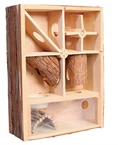
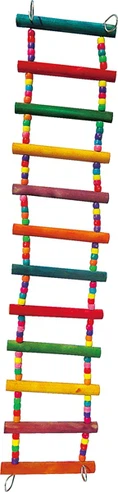
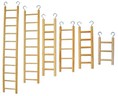
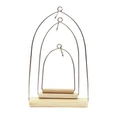
Animals need shelters, which can provide the necessary sense of security and living environment. A good shelter can protect the animals living in it from external threats.
Hamsters in the wild will choose to dig a shelter with a depth of more than half a meter and multiple holes connected. As a domestic pet, the shelter is completely provided by humans. It is naturally impossible to build a half-meter deep series of holes, so it is necessary to give priority to the purchase of a single hiding place.
-----
The hamster cage provided by the owner basically simulates the natural living environment of the hamster:
Hiding place: living, storage, nursery
Toilet and bathroom: and cleaning area
Bedding: simulate the land and create an underground environment
Terrace: Hamsters will climb to some high places (for themselves) to observe whether the surrounding environment is dangerous
1. The function of hiding
1. Insulation
Just like human beds, shelters need to have insulation properties. Staying in the cold outdoors for a long time will cause the body to lose temperature quickly. At this time, a warm shelter is a must.
2. Avoid light
Hamsters have poor eyesight and are nocturnal burrowing animals. A light-avoiding environment can give them a sense of security. Hamsters in a relaxed state have curled ears.
3. Additional functionality
Hamsters will dig multiple burrows in series in the wild for different functions, such as sleeping areas, nurseries, and storage areas. Nowadays, cleaning areas are generally replaced by containers, but the storage area is usually near the hamster's sleeping area and is not easy to separate, so the hiding place must be large enough to store food for it, after all, it is called a "hamster".
4. There is a "hole"
Hamsters are very concerned about whether there is a "hole" when hiding, and they also like to get into small areas. Many owners have a worry: "I obviously bought a large hamster nest, why does the hamster still go to the toilet?"
When providing hiding, it is best to have a small entrance, a large volume of space, and remove the lid of the bathroom/toilet.
2. Recommendations for purchasing shelters
1. Sufficient volume
The shelter must at least have enough space for the hamster to fill warm bedding, store food in moderation, and sleep. Especially when it is cold, hamsters will directly move a large amount of food into the cave to reduce their frequency of going out. If the shelter is too small, it will not only affect the insulation of the shelter, but the hamster will also be more likely to suffer from hypothermia when it frequently goes out to get food, thereby increasing the risk of "pseudo-hibernation".
The size of the shelter for dwarf hamsters should preferably be larger than 8*10 cm; the size of the shelter for bear hamsters should preferably be larger than 10*15 cm.
2. There should be an "entrance"
It is best for the shelter to have an entrance that can be "drilled", and hamsters generally use whiskers to measure the width, so the width of the shelter entrance is:
Whisker width>entrance width>hamster head width.
It does not need to be so precise, just measure it roughly, and it is also good to splice the shelter with large and small PVC pipes.
3. Opaque
Transparent shelters are not shelters, they simply satisfy the owner's desire to peek. Avoid light and fill the bedding to bring a sense of security.
Buy a few PVC tees and crosses and bury them in the bedding to meet the hamster's need to dig holes.
4. There is a skylight
Because the heat preservation brought by the shelter will lead to a large temperature difference between the inside and the outside, and the inner wall of the container will condense water vapor, which will soak the bedding and cause the bedding to not keep warm. If it is a wooden shelter or food storage, it will even mold. Therefore, it is best to open a skylight in the shelter to dissipate heat.
5. With or without a bottom, each has its advantages
The bedding without a bottom is convenient for hamsters who don't like cleanliness. Urinating randomly will make the bedding more dirty. Without a bottom, urine stains dry faster, and it is easy to clean the bedding in the urine nest.
The bedding with a bottom is more suitable for keeping warm and has higher hygiene requirements for hamsters. If your hamsters don't urinate in the nest, it will be much easier. The shelter with a bottom is convenient to clean the entire shelter at one time, reducing the waste rate of bedding.
If you use a bottomed shelter in the urinal, the urine will evaporate slowly, and the shelter will be damp for a long time, increasing the risk of disease.
For example, I used to raise a white-rumped bear, and it never urinated in the shelter, so I chose a bottomed shelter, using plastic in winter and ceramic in summer. Once a week, you only need to take out the shelter, and 50% of the dirt in the cage will be cleared (old food, feces, and toilets can account for 40%). The bedding in other areas of the cage will be clean after a month.
6. Easy to clean
Pottery, porcelain, plastic, wood, and cloth are roughly the following materials on the market.
In winter, it is recommended to have good warmth retention, such as plastic, wood, and porcelain (porcelain has good heat insulation); in summer, it is recommended to have good heat dissipation, such as pottery and porcelain (porcelain heats up slowly); plastic can be used in all seasons.
If your rat is hygienic, then it doesn't matter what material it is. If it urinates and defecates anywhere, then other materials are not recommended except plastic and ceramic.
Pottery and wood are water-absorbent, and porcelain and plastic have fine surfaces that will not seep water, but they are also more likely to form condensation.
7. Don't limit yourself to "for hamsters"
Items with the words "for hamsters" can save time in shopping, but they cost extra money. Some people call it "IQ tax", while others think "this is spending money to save time".
For hamsters to hide, some desktop trash cans are large enough and cheap, and they also meet the concept of "having a hole", which is very suitable for hamsters.
Coconut shells for birds are cheaper than those sold in hamster supply stores.
Some ashtrays with lids are also very good and very durable, such as ceramic shells.
For pure pragmatism, you can use PVC water pipes to connect one yourself, which has a very long service life. It is not a problem to "send away" ten generations of hamsters with a set of pipes.
Friends who raise dwarf hamsters can take a look at the landscaping items in aquarium stores, which are of many types and affordable.